Every The Great Gatsby Movie Adaptation, Ranked by Rotten Tomatoes
From silent-era experimentation to Baz Luhrmann’s glittering modern spectacle, each screen version of F.
F. Scott Fitzgerald’s The Great Gatsby has always seemed destined for the screen. Its ingredients are almost impossibly cinematic: lavish parties, forbidden love, glittering wealth, mysterious promises, a doomed dream and a narrator watching an entire social world collapse from the edges. Yet the novel’s appeal also creates a formidable challenge. Much of Fitzgerald’s power comes from implication, rhythm and Nick Carraway’s carefully shaped observations. A movie can show Gatsby’s mansion and fill it with music, but it must still find a way to preserve the sadness beneath the spectacle.
That tension helps explain why the film adaptations have inspired such different reactions. Some versions lean into the romance between Jay Gatsby and Daisy Buchanan. Others focus on the corruption of wealth, the cruelty of old money or the uneasy morality of Nick’s role as both participant and observer. Rotten Tomatoes offers one way to compare those interpretations, collecting the critical response to the major screen adaptations and placing them in conversation with one another. The resulting ranking is less a final verdict on Fitzgerald than a record of how different generations have approached the same story.
The question at the center of any ranking is deceptively simple: who perfectly captured Gatsby? The answer depends on which Gatsby a viewer believes matters most. Is he the dazzling host who seems to know everyone in New York? Is he the romantic who has built his life around an impossible reunion? Is he a self-invented stranger trying to purchase the past? Or is he a tragic figure whose dream becomes inseparable from the damage it causes?


The earliest adaptation arrived during the silent-film era, when filmmakers had to translate Fitzgerald’s prose without spoken dialogue. That version now belongs largely to film history rather than everyday viewing, and its survival and accessibility have long been limited compared with the later productions. Even so, its existence is important. It demonstrates how quickly Hollywood recognized the novel’s dramatic potential and tried to convert its atmosphere into visual storytelling.
A silent Gatsby faces an especially difficult problem. Fitzgerald’s novel depends on language, and Nick’s narration gives the book much of its distinctive personality. Without dialogue or audible narration, the adaptation must communicate Gatsby’s allure through faces, rooms, gestures and editing. The result can preserve the outline of the plot while losing some of the ambiguity that makes the novel endure. It is a fascinating starting point for the screen history of The Great Gatsby, even if it is not the version most viewers use as their introduction to the story.
The next major attempt came in the late 1940s, with Alan Ladd taking on the title role. This adaptation emerged at a time when Hollywood was deeply invested in polished studio dramas and recognizable star performances. Ladd brought a controlled, old-fashioned screen presence to Gatsby, presenting him as a figure whose mystery is connected to restraint. Rather than making the character a flamboyant creature of excess, the performance emphasizes the man behind the performance: someone who has constructed an identity and must protect it.


That approach has a particular strength. Gatsby is most compelling when his confidence feels slightly rehearsed, as though every gesture has been practiced for the moment Daisy might see him. A quieter interpretation can make that fragility visible. At the same time, a restrained version may struggle to convey the enormous cultural force of Gatsby’s parties and the seductive scale of his dream. The character is supposed to seem both intimate and legendary, and balancing those qualities has challenged every actor who has played him.
The 1974 adaptation is perhaps the version most closely associated with the idea of a classic prestige Gatsby. Robert Redford played Jay Gatsby, while Mia Farrow portrayed Daisy Buchanan. The production arrived with the weight of a major literary adaptation and the expectation that a celebrated cast could bring Fitzgerald’s world to life with elegance. Its costumes, locations and period atmosphere helped establish a visual template that many audiences still associate with the novel.
Redford’s Gatsby is polished, handsome and guarded. His appeal comes from the sense that the character has mastered the surface of his identity. He can host a party that fills a mansion, yet the performance also suggests a man waiting for one specific person to arrive. That contrast between public grandeur and private fixation is central to Gatsby, and the film gives it a stately, romantic treatment.

Whether that stateliness works depends on a viewer’s expectations. The novel’s emotional world is not simply beautiful; it is uncomfortable. Gatsby’s dream is built on denial, Daisy’s choices are shaped by privilege, and the wealthy characters can move through tragedy while leaving others to absorb the consequences. A film that emphasizes elegance risks making the world seem more attractive than poisonous. Critics who found the adaptation too formal or emotionally distant were responding to that imbalance, while viewers drawn to its visual refinement found a persuasive version of Fitzgerald’s melancholy.
Television offered another interpretation at the turn of the millennium. The later adaptation starring Toby Stephens as Gatsby and Mira Sorvino as Daisy approached the material through the expanded space of a television production. That format can be useful for a novel with a strong social environment. More room allows a story to linger over relationships, establish the tensions among the characters and explore the contrast between Gatsby’s carefully presented identity and the history he tries to conceal.
A television Gatsby also faces its own limitations. The story’s power depends partly on momentum: the parties, the reunion with Daisy and the steady movement toward disaster should feel as though they are drawing the characters into a trap. A longer format can deepen the background, but it can also soften the pressure of the central romance. When the narrative spends more time explaining the world, it may lose some of the haunting uncertainty that made Gatsby seem so difficult to understand.


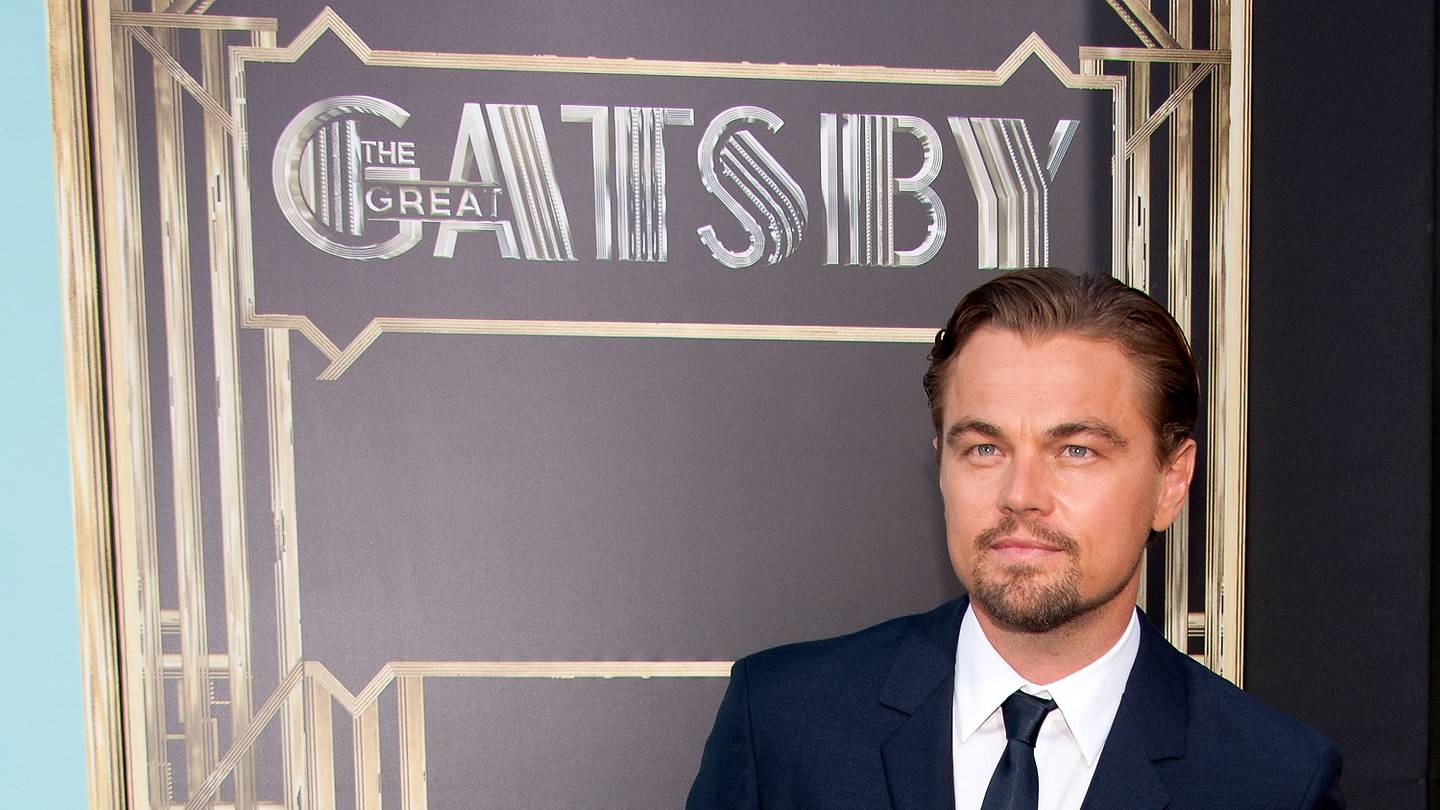
Then came Baz Luhrmann’s 2013 adaptation, with Leonardo DiCaprio as Gatsby and Carey Mulligan as Daisy. It is the most openly stylized version of the story, built around saturated color, rapid movement, elaborate production design and a contemporary musical sensibility. Luhrmann treats the novel’s extravagance as something to be experienced rather than merely observed. The parties are not background decoration; they are engines of fantasy, overwhelming the senses while hinting at the emptiness beneath them.
DiCaprio’s performance makes Gatsby’s contradictions unusually visible. He can be charming and awkward, commanding and vulnerable, theatrical and painfully sincere. The famous confidence feels like an act that sometimes slips, revealing the hopeful young man beneath the expensive clothes and practiced smile. This interpretation understands that Gatsby must be more than a wealthy romantic hero. He has to be a person who has turned longing into an entire public identity.
The 2013 film’s biggest strength is also the source of its most persistent criticism. Its energy captures the novel’s fascination with excess, but the heightened style can overwhelm the quieter emotions. Fitzgerald’s prose often creates power through what remains unsaid. Luhrmann, by contrast, tends to put feeling on the screen in bold, unmistakable forms. For some viewers, that makes the adaptation vivid and accessible. For others, it makes the story feel too loud, particularly when the tragedy calls for stillness.


Rotten Tomatoes rankings are useful precisely because they do not settle that argument. They gather critical responses, but they cannot measure every reason a viewer connects with a performance. A lower-ranked adaptation may contain a Gatsby who feels more convincing to one audience member than the celebrated version at the top. A film can be imperfect as a whole and still make one character, one scene or one emotional turn unforgettable.
Rankings also reflect the standards of their moment. Critics do not watch adaptations in a vacuum. They bring expectations about literary fidelity, acting styles, visual effects, period detail and the relationship between popular entertainment and serious drama. A version that once seemed lavish may later appear restrained. A film criticized for excess may eventually look like the adaptation that best understood the novel’s obsession with spectacle.
The strongest versions of The Great Gatsby recognize that Gatsby’s dream cannot be separated from the society that makes it necessary. He wants Daisy, but he also wants the authority, security and social legitimacy that Daisy represents. He has acquired money, a mansion and a reputation, yet none of those achievements can erase the divide between people who inherit status and people who attempt to manufacture it. The tragedy is not only that Gatsby fails to recover the past. It is that he believes the past can be recovered through enough devotion, wealth and performance.



That is why the role requires more than charisma. The actor playing Gatsby must make the dream credible while allowing the audience to see its impossibility. He must seem impressive enough for Daisy to understand the attraction, vulnerable enough for the audience to care and misguided enough for the ending to feel inevitable rather than arbitrary. Each adaptation emphasizes a different part of that balance.
Daisy presents an equally difficult challenge. She can easily become either a simple romantic ideal or a villain blamed for everything that follows. The best interpretations preserve her contradictions. Daisy is charming, frightened, privileged and capable of causing harm. She is also trapped inside a world that rewards her for avoiding responsibility. Her relationship with Gatsby is not just a love story; it is a collision between fantasy and the practical protections of wealth.
Nick, meanwhile, determines how the audience understands the entire affair. As narrator, he must be curious without becoming intrusive, sympathetic without becoming blind and critical without pretending to stand outside the moral failures around him. Film adaptations often reduce or reshape his presence because cinematic storytelling does not always need extended narration. Yet Nick’s perspective is vital. Without him, Gatsby’s story can become a straightforward romance or a glamorous tragedy instead of the complicated act of judgment found in Fitzgerald’s novel.
Looking across the adaptations, no single film completely owns the character. The silent version represents the first attempt to make the novel’s atmosphere visible. The 1940s production offers a more controlled and traditional Gatsby. The 1974 film provides the grand literary romance many viewers imagine when they think of the story. The television adaptation benefits from a broader canvas, while the 2013 movie embraces the dazzling, unstable quality of Gatsby’s world.
So who captured Jay Gatsby best? For viewers who value restraint, an older interpretation may feel most persuasive. Those drawn to romantic grandeur may prefer the version with the most polished period atmosphere. Audiences who want Gatsby’s ambition and vulnerability to burst through the screen may find DiCaprio’s performance the most complete. Rotten Tomatoes can arrange the films according to critical consensus, but it cannot choose the Gatsby who speaks most directly to an individual viewer.
That may be the lasting appeal of adapting Fitzgerald’s novel. Gatsby changes whenever the culture around him changes. One generation sees a romantic idealist, another sees a symbol of class anxiety, and another sees a self-made celebrity whose image has become more real than his life. Every film must decide which of those meanings deserves the spotlight. The ranking is therefore only the beginning of the conversation. The more interesting question remains personal: when the lights go down and the party is over, which Gatsby still lingers in the mind?