The Amazing Spider-Man’s 1977–1978 Newspaper Adventures Return in a New Clover Press Collection
Clover Press is bringing together The Amazing Spider-Man’s classic 1977–1978 newspaper comics, including encounters with Doctor Octopus, Mysterio and other threats from Marvel’s past.
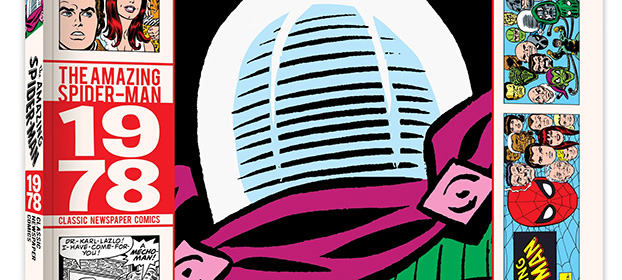
Spider-Man’s history is usually associated with comic-book issues, landmark storylines and the familiar monthly rhythm of Marvel publishing. Yet one important part of the character’s legacy developed outside the traditional comic-book format. The wall-crawler also appeared in newspaper strips, bringing Peter Parker and his alter ego to readers through a daily and ongoing form of storytelling. A new collection from Clover Press revisits that largely overlooked period with The Amazing Spider-Man: Classic Newspaper Comics 1977–1978.
The collection focuses on Spider-Man’s newspaper adventures from 1977 and 1978, a period in which the hero faced recognizable Marvel villains including Doctor Octopus and Mysterio. The project offers readers an opportunity to see how Spider-Man functioned in a different publishing environment, one built for newspaper audiences rather than the standard comic-book market.
That distinction is central to the appeal of the book. Newspaper comics occupied a different place in everyday culture from comic-shop or newsstand issues. They were encountered as part of a broader newspaper page, often by readers who might not have been following Marvel’s regular publications. A newspaper strip therefore had to serve as an accessible point of entry while still delivering the energy, danger and personality associated with Spider-Man.
Advertisement


The 1977–1978 material collected by Clover Press represents a version of Marvel history that can be easy to miss. Well-known comic-book eras tend to dominate discussions of Spider-Man, while the character’s newspaper appearances can receive less attention. Bringing these strips together gives that material a more visible place in the larger story of the character’s publication history.
At the center of the collection is the familiar conflict between Spider-Man and a gallery of adversaries. Doctor Octopus and Mysterio are specifically identified among the opponents appearing in these adventures. Their inclusion highlights an important strength of the newspaper strip concept: it could use characters already associated with Spider-Man while presenting them within a distinct serialized format.
Doctor Octopus is one of the classic figures connected to Spider-Man’s world, and his appearance signals a confrontation with a threat that is immediately recognizable to Marvel readers. Mysterio brings a different kind of challenge, associated with illusion and uncertainty. Even without relying on detailed knowledge of the individual strips, the presence of these villains shows that the collection is rooted in the broader Spider-Man mythos rather than being an unrelated adaptation.
Advertisement



The summary for the book also points to “more” than those two antagonists. That suggests a wider selection of conflicts across the 1977–1978 material, although the available information does not identify every villain or storyline included. The collection’s appeal consequently lies both in its recognizable elements and in the chance to encounter less familiar episodes from this part of Spider-Man’s history.
Newspaper strips also create particular storytelling demands. A comic-book issue can be read as a complete unit, while a newspaper strip is designed to unfold in smaller installments. Readers return to the story repeatedly, following the action in stages. This structure makes the rhythm of the original publication part of the experience, especially when the strips are gathered into a single volume.
For Spider-Man, that serialized approach is a natural fit. The character’s adventures combine action, suspense and personal complications, all of which can be extended across continuing installments. The reader is invited to follow each development and return for the next step. In a collected edition, those segments can also be considered as a sustained record of how the character was presented to newspaper audiences in the late 1970s.
Advertisement



The word “classic” in the title places the collection within a preservation-minded view of Marvel history. It is not simply a new Spider-Man story using older characters. It is a recovery of previously published material from a specific period and format. That makes the book relevant to readers interested in the history of comics as well as to fans looking for another way to experience the web-slinger.
The collection may be especially valuable for readers whose understanding of Spider-Man has been shaped primarily by comic books, television, film or more recent publishing. Each medium emphasizes different aspects of a character. A newspaper strip had to communicate quickly and clearly, and it reached its audience in the routine setting of the daily paper. Seeing Spider-Man in that context can broaden the picture of how Marvel characters circulated beyond their best-known venues.
It also underlines the durability of the character. Spider-Man could be adapted to a format with different expectations while remaining recognizable as Spider-Man. The essentials were still present in the premise described for the collection: a hero confronting dangerous foes, including Doctor Octopus and Mysterio, across a continuing series of adventures. The newspaper setting did not erase the character’s identity; it provided another framework in which that identity could operate.
Advertisement

The 1977–1978 date range gives the book a clear historical focus. Rather than presenting an undefined selection of old strips, the volume is tied to two consecutive years. That focus allows readers to examine a particular moment in the newspaper feature’s life and to experience the material as a record of a defined period. It also distinguishes the book from broader Spider-Man anthologies that may draw from multiple decades or formats.
Collections such as this one can serve two audiences at once. Longtime Marvel readers may approach the volume as an opportunity to revisit a forgotten corner of the character’s publishing history. Newer readers may use it as an introduction to a form of Spider-Man storytelling they have not previously encountered. Because the central figures are familiar, the book can remain approachable even for someone who has never read the original newspaper appearances.
The presence of Doctor Octopus and Mysterio gives that accessibility a strong foundation. These villains are recognizable names, but their inclusion is also a reminder that Spider-Man’s supporting cast and adversaries have been carried across different versions of the character’s history. The collection therefore connects the newspaper material to the larger Marvel tradition while preserving its identity as a distinct body of work.
Advertisement

There is also a historical value in collecting material that might otherwise remain scattered. Newspaper strips were originally encountered in individual installments, making their long-term preservation and rereading dependent on access to the publications in which they appeared. A dedicated volume changes that experience by gathering the material into one place. Clover Press’s project presents the 1977–1978 adventures as something that can be studied, revisited and appreciated as a complete period of Spider-Man’s newspaper presence.
The collection’s significance does not depend on claiming that these strips replaced or surpassed Spider-Man’s regular comic books. Their importance is different. They show how the character was made available to another audience and how Marvel history extends beyond the most frequently discussed titles. For readers interested in the evolution of popular characters, that kind of parallel history can be just as revealing as a famous comic-book storyline.
It is worth approaching the volume with an awareness of its historical position. The stories come from the late 1970s, and their value is tied to the way they represent Spider-Man during that period. Readers may be interested in the conventions of the era, the handling of familiar villains and the process of adapting a superhero to the newspaper strip format. The collection offers a chance to consider those elements together instead of treating the strips as isolated curiosities.
Advertisement



The choice of Spider-Man is particularly fitting for an archive of this kind. The character is widely associated with movement, visual action and the contrast between ordinary life and extraordinary danger. A newspaper strip could bring those qualities to readers in brief, recurring installments. The available description does not provide detailed information about individual scenes or story arcs, but it does establish the basic promise: Spider-Man faces Doctor Octopus, Mysterio and additional threats in a selection drawn from 1977 and 1978.
That promise should appeal to collectors of Marvel material, fans of Spider-Man’s classic opponents and readers interested in the history of syndicated-style comics. It may also appeal to anyone curious about what happens when a well-known superhero is removed from the expectations of a conventional comic-book issue and placed into a feature encountered as part of a newspaper’s regular flow.
Clover Press’s collection consequently functions as both a Spider-Man book and a document of comics history. It preserves adventures that are described as a forgotten part of Marvel’s past, while making them available in a form that invites modern readers to examine them anew. The emphasis is not only on the villains Spider-Man battles, but also on the existence of this alternate route through the character’s publishing life.
Advertisement


:max_bytes(150000):strip_icc()/marvel-wolverine-video-game-091826-9c0fced69e42415196a9ee81b37032bc.jpg)
For fans, the most immediate attraction will be the chance to see Spider-Man confront classic foes in stories from a specific late-1970s period. For historians and collectors, the attraction is broader: the volume acknowledges that Marvel’s history was built across more than one kind of publication. By collecting the 1977–1978 newspaper comics, Clover Press helps ensure that this chapter is not reduced to a footnote.
The Amazing Spider-Man: Classic Newspaper Comics 1977–1978 stands as a reminder that even a character as familiar as Spider-Man can have unexplored corners. Doctor Octopus, Mysterio and other threats provide the recognizable Marvel connection, while the newspaper format gives the material its distinctive identity. For anyone seeking a different view of Spider-Man’s past, this collection offers a focused look at two years of adventures that deserve to be remembered.