Marvel Launches Alien vs. X-Men #1
Chris Claremont and Kieron Gillen bring the Xenomorphs into conflict with Kitty Pryde and the Brood in a new four-issue Marvel crossover.
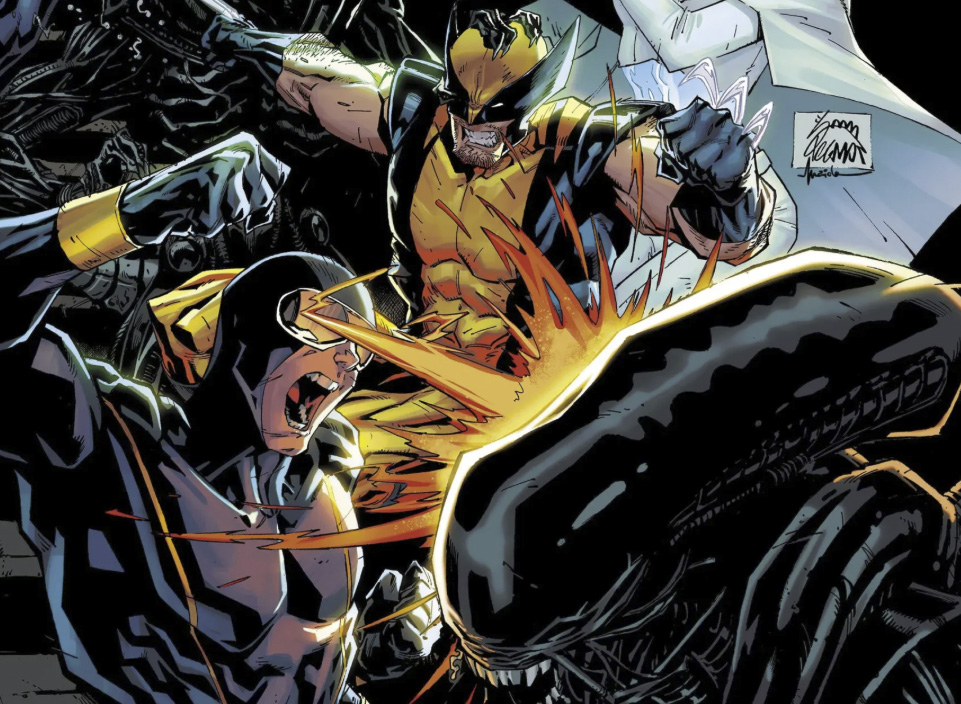
Marvel has launched Alien vs. X-Men #1, a new four-issue crossover that places the Xenomorphs in the path of Kitty Pryde and the Brood. The series brings together two of science fiction and superhero comics’ most recognizable threats while pairing them with one of the X-Men’s most enduring heroes.
The project is written by Chris Claremont and Kieron Gillen, two creators with deep connections to the world of the X-Men. Their collaboration gives the series an immediate sense of importance, particularly because the story is built around Kitty Pryde and the Brood, characters whose histories are closely tied to the darker, more cosmic side of Marvel’s mutant mythology.
The first issue is on sale now, beginning a story planned to run for four issues. Marvel’s announcement positions the series as a direct collision between the Xenomorphs and the X-Men universe rather than a simple appearance by one property inside the other. The result is a crossover designed around a fundamental question: what happens when the X-Men face an enemy as relentless and alien as the Brood, while the Xenomorphs enter that same dangerous environment?


That premise gives Alien vs. X-Men a particularly strong foundation. The Xenomorphs are defined by their predatory nature and terrifying life cycle, while the Brood represent a deeply unsettling threat within the X-Men’s corner of Marvel. Bringing the two forces together creates a conflict in which danger comes from more than one direction. Kitty Pryde, caught between those forces, becomes the human and mutant perspective through which readers can enter the crossover.
Kitty has long occupied a distinctive place among the X-Men. She is often associated with intelligence, courage, and adaptability, qualities that become especially valuable when the threat facing her cannot be handled through straightforward strength alone. Her ability to phase through solid objects has also made her one of Marvel’s most visually distinctive heroes. Although the available announcement does not reveal the full details of her role in the new series, placing her at the center of the conflict immediately suggests a story built around survival, strategy, and impossible choices.
The Brood add another layer to the story. Within the X-Men mythos, they are not merely conventional villains. Their presence is connected to horror, transformation, and the fear of losing control of one’s own body. Those themes make them a natural counterpart to the Xenomorphs, whose reputation is likewise rooted in physical menace and visceral science fiction horror. The crossover therefore has a clear thematic connection even before the two sides meet on the page.


That connection is one of the most compelling reasons for the project’s existence. A crossover works best when its ingredients share more than a recognizable logo. In this case, the Xenomorphs and the Brood belong to different fictional worlds, but both have been used to explore the fear of an unknown organism invading a familiar environment. Their meeting allows Marvel to emphasize that common ground while still treating each threat as distinct.
Chris Claremont’s involvement is especially notable for readers who have followed the evolution of the X-Men. Claremont is one of the most influential writers in the franchise’s history, and his work helped establish many of the emotional, political, and cosmic dimensions that continue to define the team. His association with Kitty Pryde and the broader X-Men mythology makes his participation in this crossover a meaningful part of the announcement.
Kieron Gillen brings another important connection to the project. His work with Marvel has included stories shaped by large-scale mythology, complex character relationships, and conflicts that combine personal stakes with cosmic consequences. Working alongside Claremont gives Alien vs. X-Men a creative pairing that connects different eras of X-Men storytelling.


The collaboration also reflects the unusual nature of the crossover itself. The series needs to honor the identity of the Alien franchise while remaining recognizably part of the X-Men universe. It must also give the Brood and Kitty Pryde a meaningful place in the story rather than treating them as background elements in a fight between monsters. The involvement of two writers associated with ambitious genre storytelling suggests that the series is intended to be more than a brief novelty.
At the center of the launch is the promise of escalation. The X-Men have confronted the Brood before, and the Xenomorphs have built their reputation through stories focused on isolated danger, relentless pursuit, and the struggle to stay alive. Combining those traditions creates a setting in which even experienced heroes may find their usual methods tested. Kitty’s presence sharpens that tension because her strengths are rooted in movement, timing, and quick thinking rather than simple domination of the battlefield.
Marvel has not supplied every detail of the plot in the announcement, and that restraint leaves room for the first issue to establish the shape of the conflict. Readers know the central participants and the length of the series, but the precise circumstances that bring them together remain part of the experience of reading the comic. The launch therefore invites audiences to discover how the Xenomorphs enter Kitty Pryde’s story and how the Brood become involved in the resulting confrontation.

That limited setup is appropriate for a crossover built around suspense. The less familiar the circumstances, the more effective the sense of danger can be. What is clear is that the series has chosen a focused cast of major threats and a central X-Men character rather than attempting to involve every possible hero. A compact four-issue structure can give the story a brisk shape, allowing the conflict to develop without requiring readers to commit to a long-running line.
The four-issue format may also help preserve the impact of the premise. Crossovers can sometimes become difficult to follow when they expand across numerous titles or tie-ins. Alien vs. X-Men is presented as a contained series, giving the conflict a defined beginning and an expected conclusion. For readers who enjoy both properties but want a story with a clear point of entry, the first issue offers that opportunity.
There is also an important tonal appeal to the project. X-Men stories can move between superhero action, personal drama, social allegory, and space opera. Alien stories are commonly associated with horror and survival. The Brood sit near the point where those tones overlap, making them a natural bridge between the two franchises. A story involving Kitty, the Brood, and the Xenomorphs can therefore move from action to dread without leaving the basic logic of either setting.


For general readers, the premise is easy to understand even without a detailed knowledge of Marvel continuity. Kitty Pryde is an X-Men hero facing two dangerous extraterrestrial forces. The Xenomorphs bring their reputation as deadly alien predators, while the Brood bring their established place as a menacing part of mutant history. The essential conflict needs little additional explanation: a familiar hero is placed between threats that are each dangerous enough to dominate a story on their own.
For longtime X-Men readers, the appeal lies in the specific choice of Kitty and the Brood. Kitty is not an arbitrary representative of the team, and the Brood are not an interchangeable group of villains. Their inclusion points toward the franchise’s history with science fiction horror and toward the particular kind of story in which survival depends on more than physical power. The crossover can draw on that history while still offering a new combination of characters and threats.
The launch also shows how recognizable genre properties can be connected through shared themes. The Xenomorphs and the X-Men come from different traditions, yet both have spent decades asking questions about identity, fear, otherness, and the limits of the human body. The Brood intensify those concerns within Marvel’s universe. Even before the story’s later developments are known, the crossover has a foundation that goes beyond the immediate spectacle of seeing two famous creatures collide.


As the series begins, the most important promise is not simply that the Xenomorphs will fight the Brood. It is that Kitty Pryde will have to navigate a conflict in which neither side can be treated as an ordinary enemy. That creates opportunities for suspense and character-driven storytelling, while the four-issue format keeps the narrative focused. The question is not only which threat is stronger, but how Kitty can respond when every option carries its own danger.
Alien vs. X-Men #1 is available now, launching Marvel’s four-issue crossover from Chris Claremont and Kieron Gillen. With Kitty Pryde at the center and the Xenomorphs set against the Brood, the series brings together a classic X-Men character, a familiar mutant menace, and one of science fiction’s most recognizable creatures. The first issue marks the beginning of that collision, with the remaining chapters set to reveal how far the conflict can spread.