Marvel Announces Midnight X-Men, Midnight Spider-Man and Midnight Fantastic Four for October 2026
Marvel’s Midnight lineup will arrive on October 7, 2026, with new #1 issues for the X-Men, Spider-Man and Fantastic Four, featuring Jonathan Hickman, Benjamin Percy and Phillip Kennedy Johnson.
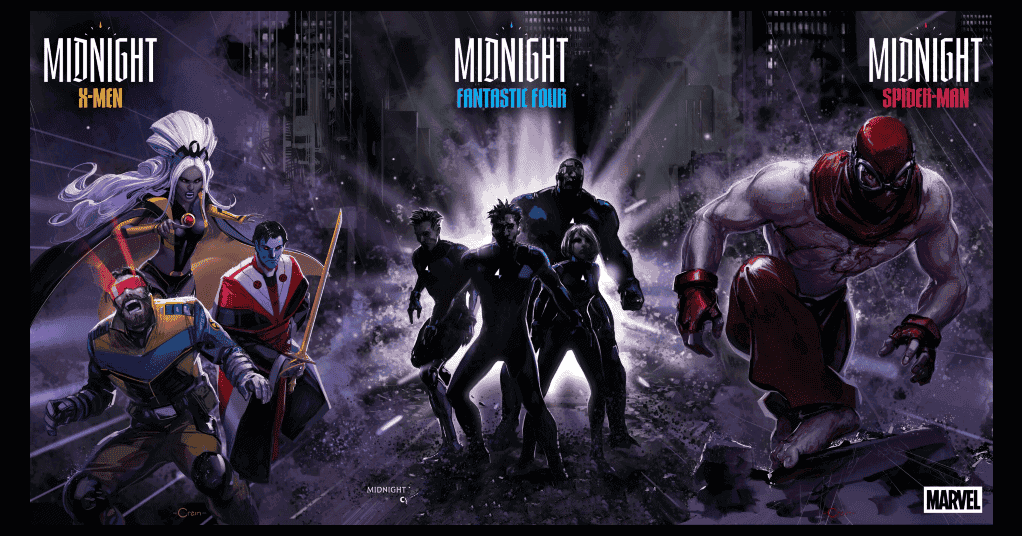
Marvel is preparing to usher in a darker new publishing era with three titles arriving under the banner of Midnight. Midnight X-Men #1, Midnight Fantastic Four #1 and Midnight Spider-Man #1 are scheduled to reach comic shops and digital platforms on October 7, 2026. The announcement presents the three issues as a connected moment in Marvel’s publishing calendar, while leaving the stories themselves largely concealed for now.
The October release date gives readers a single day on which to encounter the opening chapters of this new phase. Each title carries the familiar name of one of Marvel’s most recognizable properties, but the Midnight branding signals that these books are intended to be read as something distinct from ordinary launches. The phrase “dark dawn of a new era” is central to the announcement, creating an atmosphere of change without revealing the precise threats, settings or character developments that await inside the books.
For general readers, the lineup is immediately recognizable. The X-Men are Marvel’s team of mutant heroes, Spider-Man is one of the company’s best-known individual characters, and the Fantastic Four are a foundational superhero family. Bringing all three names into the same Midnight announcement gives the release considerable breadth. It also offers different entry points for readers who may follow one corner of the Marvel Universe more closely than the others.


Midnight X-Men #1 is associated with Jonathan Hickman. Hickman is identified in the announcement as the creative name attached to the X-Men issue, making his involvement one of the principal reasons the title has drawn attention. The issue’s story details have not been supplied, so Marvel has not yet publicly established which members of the team will appear, what crisis they will face or how the book will fit into the wider Midnight initiative.
That lack of information is part of the appeal of a first issue. A number one issue traditionally serves as a doorway into a new storyline, giving readers a fresh starting point while establishing the direction of a series. In the case of Midnight X-Men, the available announcement confirms the title, its release date and Hickman’s connection to the project. It does not provide a synopsis, character roster or description of the book’s visual approach. Readers will therefore have to wait for further previews or for the issue’s publication before the concept can be fully understood.
Midnight Fantastic Four #1 carries the name of Benjamin Percy. Like the X-Men project, the Fantastic Four title is being presented as a first issue and as part of Marvel’s October 7 launch. The announcement does not disclose the plot or explain whether the series will focus on a particular member of the family, a team-wide challenge or a broader transformation of the Marvel setting. At this stage, the title and the creator association are the confirmed points of information.


The Fantastic Four occupy a special place in Marvel’s publishing history, and a new number one naturally invites questions about how the family will be portrayed in this darker setting. However, the supplied details stop short of answering those questions. There is no confirmed account of the team’s status, no stated location for the story and no named antagonist attached to the announcement. The Midnight label establishes the tone of the reveal, but it does not replace a full synopsis.
The third project, Midnight Spider-Man #1, is associated with Phillip Kennedy Johnson. Spider-Man gives the Midnight lineup a solo focus, contrasting with the team-based identities of the X-Men and Fantastic Four. The announcement confirms that the issue will be available on the same October date as the other two launches, but it offers no story summary or indication of which version of Spider-Man will headline the book.
That distinction is important because the announcement does not specify supporting characters, continuity details or the scope of the Spider-Man story. It would be premature to assume how the title connects to the other Midnight books, or even whether the three issues share a direct narrative. For now, Marvel has presented them together as part of a new era, while leaving the nature of their relationship open.



What is clear is the deliberate range of the lineup. Midnight X-Men #1 represents a major mutant team, Midnight Fantastic Four #1 centers on Marvel’s science-fiction superhero family, and Midnight Spider-Man #1 focuses on a character whose identity is known far beyond comic-book readership. The combination allows Marvel to frame Midnight as a broad initiative rather than a launch limited to one corner of its catalog.
The wording of the announcement also suggests that atmosphere will matter. “The clock strikes midnight” evokes a precise turning point, while “dark dawn” creates a contrast between an ending and a beginning. Together, those images imply that the books are meant to feel like the start of something consequential. Still, the material currently available does not explain whether midnight is a literal story element, a thematic phrase or simply the name of the publishing initiative.
For readers who follow Marvel’s creators, the three names attached to the projects provide another reason to watch the launch. Hickman’s association with Midnight X-Men, Percy’s with Midnight Fantastic Four and Johnson’s with Midnight Spider-Man gives each title an individual creative identity within the shared announcement. The source material does not list full creative teams, artists, editors or additional contributors, so those details remain unconfirmed.


The October 7, 2026 release will also make accessibility part of the event. Marvel is expected to place the issues on comic-shop shelves and digital platforms on the same day, according to the announcement. That means readers can choose between a physical copy and a digital edition rather than waiting for separate release windows. It also allows the three issues to be explored by audiences in different ways, whether someone prefers collecting printed comics or reading on a digital device.
Because all three issues are scheduled together, reading order may become a natural question. At present, Marvel has not announced an official sequence. The titles have been revealed as a group, but the supplied information does not say whether one book leads directly into another or whether they are independent introductions linked only by the Midnight banner. Readers should therefore treat the October release as a coordinated arrival rather than assume that one issue must be read first.
The use of #1 on each title is equally significant from a practical standpoint. New readers often look for a clear place to begin, and a first issue offers that opportunity without requiring knowledge of a long run. Existing Marvel readers may approach the books with expectations shaped by earlier versions of these characters, while newcomers can use the individual debuts as entry points. Exactly how much prior continuity will matter cannot yet be determined from the announcement.


Marvel has not provided enough information to identify the central conflicts in the three books, and that restraint prevents a more detailed plot assessment. There are no confirmed villains, settings, opening scenes or character arcs in the supplied material. Any claim about those elements would go beyond what has been announced. What can be said with confidence is that the books are positioned as beginnings, that they are connected in presentation, and that their tone is being marketed as darker and transformative.
The title Midnight itself may also help distinguish these projects from routine relaunches. A standard number one can refresh a character or introduce a new creative direction, but a named initiative gives readers a larger frame in which to view separate series. Whether Midnight will develop into a continuing line, a limited publishing event or another form of Marvel storytelling has not been stated. The October issues will likely provide the first substantial evidence of what the label means in practice.
For collectors, the simultaneous release of three number ones creates a notable snapshot of Marvel’s plans for the period. For casual readers, it offers a simple choice among three familiar names. And for fans of the creators involved, it provides an opportunity to see how Hickman, Percy and Johnson approach characters associated with different traditions of superhero storytelling. Those distinctions may become clearer when Marvel releases additional material, but they are not yet defined by the announcement itself.


The announcement’s strongest promise is therefore one of direction rather than detail. Marvel is signaling a shift, choosing language associated with darkness, transition and a new beginning. It is pairing that message with three highly recognizable franchises and a release date that places all of them in the same spotlight. The result is an intentionally open invitation: readers know when the Midnight era begins, which books are included and which creators are attached, but not yet what awaits them inside the pages.
On October 7, 2026, Midnight X-Men #1, Midnight Fantastic Four #1 and Midnight Spider-Man #1 will be available in print and digitally. Until then, the mystery remains part of the launch. Marvel has established the hour, named the books and raised the curtain on a darker new phase, leaving the stories themselves to deliver the meaning behind that midnight arrival.